How to Buy the Right Microscope

An illustrated guide to the Microscope.
About this e-Book
When we started GreatScopes Microscopes in the mid 90's, we found that many buyers were making expensive decisions based on a photograph and price alone. Dedicated as much to education as to supplying quality equipment, we wrote this e-Book. Constantly updated, it has been read hundreds of thousands of times here at GreatScopes and at MicroScopes.org.
Enjoy!

Got Microscope Confusion?
Are you puzzled over:
- What lighting is best
- How to compare optics
- Which components you need
- ABBE, Iris, and DIN? Huh?
- The major components of a student microscope
- Important concerns about construction
- Types of objective lenses
- Major types of illumination
- Focus and gear ratio
- Lesser known components
- About buying used equipment
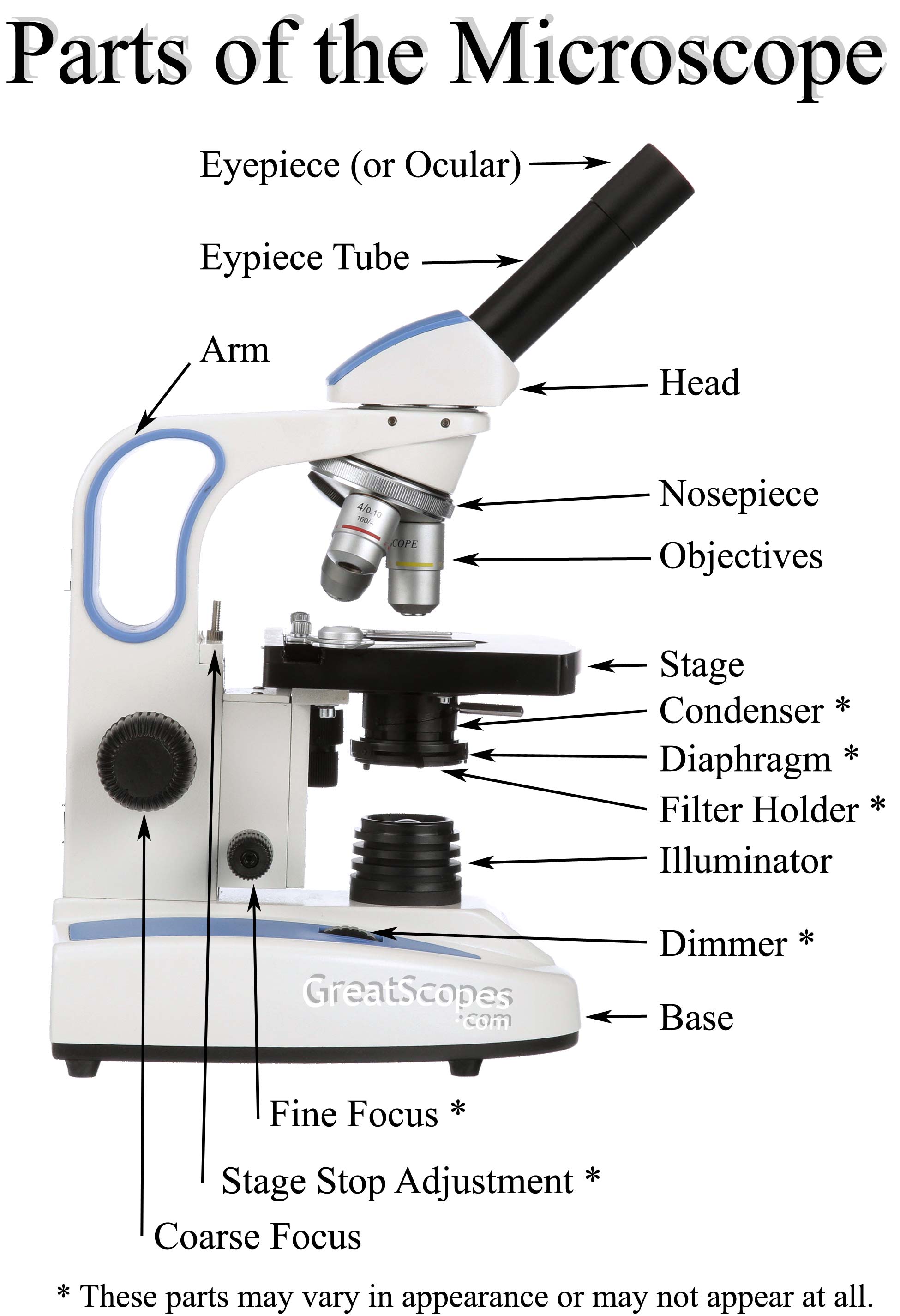


Basic Microscope Construction
Start by looking at microscopes with sturdy, well-built frames. The best are made of metallic alloys that minimize vibration, minimizing fluctuation with temperature variations. If a scope you are considering is made of plastic, walk away! It will not provide the performance you expect let alone hold up over time.
I've seen some toy scopes that are painted or chromed to look metal - so be careful! When in doubt, ask or find out.
Additionally you'll want:
- Optical glass lenses
- Metal focus gears fastened with metal screws to metal frames
- Reagent resistant finish (the "paint job")
- Ball bearings (not just grease) in vital moving parts.
While some aspects of construction are difficult to discern online or in a catalog, comparing actual weights (not shipping weight) and measurements can also give some indication of size and sturdiness.
All of GreatScopes' microscopes have rugged alloy frames, optical glass lenses, metal gear trains, reagent resistant finishes (painted, sanded, painted again, then baked for durability), and ball bearing moving parts.


Microscope Optics
Optics are pretty important, so this is the longest topic in the e-book.
 Standards for Objective Lenses
There are two main standards in microscope objectives: "DIN" & "Infinity".
DIN, or "Deutsche Industrie Norm", is found on student microscopes and more reasonably priced professional equipment. DIN was pretty much "the" standard until this new century in which Infinity optics became more accessible due to dropping prices.
Make sure your compound microscope follows one of these two standards. In doing so, you'll be assured that
- your optics are properly color corrected
- your objective lenses can be readily replaced if damaged
On a student compound microscopes (the subject of this tutorial) or lower priced professional equipment, verify that DIN objectives are supplied.
Once the price is around $1,000 or so, you're more likely to see Infinity optics. (Usually, but not always, you'll see the "∞" symbol printed right on the objective.)
I mentioned two standards that are most common, actually, there are three. A third is "no standard". Avoid it.
Look for DIN or Infinity in the advertisement, or ASK! For most hobbyists, DIN is fine. Even most medical and veterinary clinics we sell to are buying DIN. You'll pay a premium for Infinity, but these days laboratories demand it. But PLEASE, avoid that third standard, which is no standard at all, something you'll find in the cheapest microscopes.
Achromatic - Plan - Semi-Plan
Some other terms with respect to optics are "Achromatic", "Semi-Plan", and "Plan".
First, the lenses are constructed to be "color corrected". A single objective lens on a microscope can be built with six, eight, ten or more glass lenses. (That is what gives a "Compound Microscope" its name.) If the design and construction were not right, some colors could be out of the focal plane, and thus are unseen. (Focal plane refers to the area in focus, which is by definition a specific distance from the objective.)
If the lens is not color corrected, there are things that you simply will not see with your microscope. They are there, but they cannot be seen. Achromatic lenses are color corrected.
Secondly, the achromatic standard specifies that the center 60% of the field of view appears as flat and focused without aberration. (An aberration is an optical distortion caused by a defect in a lens.)
When constructing fine lenses, very exacting processes are followed. With an Achromatic lens, any chromatic (color) and spherical (focus/flatness of field) aberrations will be in the outer 40% of the field of view. Usually, the outer rim of the field of view will appear to curve up out of focus. This is normal, and since our tendency is to center the subject, most will not even notice these tendencies.
You may think, "I want my lenses to be 100% free of aberration!" Lenses of this type (called "Plan Achromatic"), are expensive, and are usually found on the fine medical and research scopes, usually costing $1000 dollars or more.
Achromatic lenses will serve you well for most student, school, and hobbyist applications.
The next grade is "Semi-Plan". Aberrations are generally located in the outer 20% of the field of view. Finally, "Plan" optics are exceptionally flat field to the edge, and for all practical purposes, are 100% free of aberration.
By contrast, cheap toy store microscopes usually have plastic lenses with fuzzy images.
All of our student microscopes are DIN threaded and have fine achromatic objectives. Scopes in our Revelation and i4 Professional line also offer semi-plan or plan objectives.
Our customers (which have included doctors, nurses, lab technicians, pathologists, teachers, homeschoolers, and hobbyists) have been delighted with the superb optics on our scopes.
 Eyepieces
We've taken a look at the objectives, now we'll talk about the lens closest to your eye, the eyepiece (also called the ocular). You should look for a microscope with a "wide field" eyepiece. On a wide field eyepiece, the lens opening is significantly larger than one that isn't wide field.
This will help you in two ways.
First of all, it is easier to position your eye to see into a wide field eyepiece. The reason is simple. Imagine trying to peer into a box through a pinhole. It would be pretty tough. Now think about trying to look in through a half-inch hole. The larger the hole is, the easier it is to see within. It is the same way with the microscope.
The lens in a wide field eyepiece is usually 18mm, generally as large as a U.S. dime. This makes it easier to position your eye for viewing.
Best of all, it also makes it much easier for children to see. I have seen two and three year old children look into a wide field lens with no problem, and see what had been brought into focus. (Young children don't have the fine motor skills to focus and such - they'll need help with that- but they will have no problem seeing while using a wide field eyepiece.)
A wide field eyepiece will also widen your field of view, that is, the width of what you see. As a result, you will not have to move the slide as much while you are viewing.
Let's discuss the topic of changeable eyepieces.
If your microscope features changeable eyepieces, change them quickly when doing so. The reason is that each time you change eyepiece(s), you can introduce dust into the microscope in the places that are hardest to clean. It takes less than a second if you prepare for it properly.
Your best bet is to make a decision concerning what eyepiece and objectives you need or intend to use most, install them on the scope, and leave them alone as much as possible.
To keep down dust intrusion in your scope, keep it covered with the dust cover when not in use, and minimize the removal of objectives and eyepieces.
Resolution
Please understand that microscope resolution (or the ability to see close but separate points as distinct) comes from the objective lenses, not the eyepieces. All an eyepiece can do is magnify the resolution that is already provided by the objective.
Perhaps an illustration from photography will best explain this concept. If you were to take a photograph of your hand, and then magnify that photograph 1000 times, you will not see microscopic skin cells. Once the picture is taken, the resolution, or the amount of detail, is forever locked in. Intense magnification will only reveal the graininess of the film used, not increased detail in the subject photographed.
In a similar fashion, it is the OBJECTIVE lenses that provide the resolution, that is, the amount of detail that will be captured and relayed to the eyepieces. The eyepieces can only magnify that detail, but cannot add to it. By nature, a higher power objective of the same grade is going to collect more detail than a lower powered one.
A 40x objective and a 10x eyepiece will result in a higher resolution (sharper detail) image than a 20x objective and a 20x eyepiece. Total magnification is the same (achieved by multiplying the two numbers), but the detail, the resolution, will be better with the 40x objective.
GreatScopes' microscopes feature wide field eyepieces. All of our student/hobbyist scopes employ the widely accepted 40/100/400x configuration, which provides an excellent range of magnification. Several student models and all of our professional line also have 1000x.
 Monocular
or Binocular?
Monocular
or Binocular?
We are frequently asked if it is better to have one eyepiece or two.
There is not a "one size fits all" answer to this question. The answer depends partially upon your situation - that is, how you will use the scope, and on your budget.
If you will be using your microscope day in and day out for hours at a time, you need binocular (two eyepieces). There is no question about it. Binocular viewing is much more comfortable because you don't have to train your brain to ignore the information from one eye. You'll notice that just about every professional microscope on the market is binocular. Those who use these scopes need the comfort associated with two eyepieces.
 That having been said, if your primary intent for this microscope is for
use by a child, you actually may find that a monocular (one eyepiece) microscope
is more appropriate for them. Sometimes children can have a difficult time
with the interpupillary adjustment. Just like a pair of binoculars, a binocular
microscope is adjustable to allow for different size people. The eyepiece
distance is adjusted until a single image is seen. Sometimes little ones
have a tough time with this. If you must have binocular though, just have
them move their eyes over one space and just use one eyepiece until they
are a little older.
That having been said, if your primary intent for this microscope is for
use by a child, you actually may find that a monocular (one eyepiece) microscope
is more appropriate for them. Sometimes children can have a difficult time
with the interpupillary adjustment. Just like a pair of binoculars, a binocular
microscope is adjustable to allow for different size people. The eyepiece
distance is adjusted until a single image is seen. Sometimes little ones
have a tough time with this. If you must have binocular though, just have
them move their eyes over one space and just use one eyepiece until they
are a little older.


Microscope Lighting
Lighting is a critically important part of your microscope – don’t ignore it when making your choice. There are major differences in lighting systems on scopes today. You'll likely find one of three types of lighting systems on student microscopes on the market.
- LED
- Fluorescent
- Tungsten/Incandescent
In household lighting in the past several years we have seen the bulbs progress from incandescent (think Edison), to fluorescent (think curlycue), to LED (think efficient!). The same progression has taken place in student microscopes.
Make sure your new microscope has LED lighting, or at very least fluorescent. As of this writing, there are some very cheaply made microscopes available with tungsten lighting, which should be avoided.
LED
 LED (Light Emitting Diode) is
the latest technology, and it brings many advantages. LEDs consume very little power,
the bulbs last a long, long time, and they provide a cool white light, protecting the
integrity of your specimens.
LED (Light Emitting Diode) is
the latest technology, and it brings many advantages. LEDs consume very little power,
the bulbs last a long, long time, and they provide a cool white light, protecting the
integrity of your specimens.
While LEDs have become more and more common on student microscopes, they are now standard on newer professional microscopes, like our 3000-LED and Revelation III. Recent technology advances have made these bulbs brighter and more reliable.
If you decide LED is for you, make sure it is dimmable. We've seen them TOO bright with only an on/off switch, making them painful to use.
Many LED student microscopes are cordless and rechargeable, so the microscope can be taken out and used without having to run a cord to plug them in. Very convenient!
Fluorescent
While LED has become king of microscope lighting, some student microscopes do still have fluorescent lighting. It is a fairly white light when compared to incandescent (below), and operates at much cooler temperatures. The bulbs, in most cases, are readily available desk lamp bulbs easily found at home improvement stores.
Tungsten
 Avoid any new
or used microscope with a tungsten/incandescent light. The bulbs are extremely hot,
produce yellow light, and were never standardized, so replacements can be very difficult
to find. As mentioned earlier, there are some very cheap scopes around with these bulbs, so
be
careful when shopping.
Avoid any new
or used microscope with a tungsten/incandescent light. The bulbs are extremely hot,
produce yellow light, and were never standardized, so replacements can be very difficult
to find. As mentioned earlier, there are some very cheap scopes around with these bulbs, so
be
careful when shopping.
Halogen
 Halogen was seen primarily in
medical and lab scopes, and rarely on student scopes. Halogen lamps provide a
very white, bright, concentrated light, and were preferred on medical and lab
instruments until just a few years back when LED took over. Halogen scopes are usually
fitted with a dimmer, which decreases the heat as well as light.
Halogen was seen primarily in
medical and lab scopes, and rarely on student scopes. Halogen lamps provide a
very white, bright, concentrated light, and were preferred on medical and lab
instruments until just a few years back when LED took over. Halogen scopes are usually
fitted with a dimmer, which decreases the heat as well as light.
If you are purchasing a binocular (two eyepiece) microscope, LED or Halogen is a must because of its brightness.
All of GreatScopes' student scopes have either fluorescent or LED lighting systems. Our professional scopes feature LED lighting.


Microscope Focus
 Okay, we've got good optics and lighting, now we've got to focus.
Insure that the student microscope you buy has coarse and fine focus, with metal gears, as well as a slip clutch.
Coarse Focus
Every modern microscope has at least a coarse focus knob. If there are two knobs, it is the larger. It is used to find the specimen, and bring it into a rough focus.
Fine Focus
Fine focus provides the finesse needed to view the various levels of the magnified subject. Your specimen is not only being magnified horizontally (i.e., a dot is magnified and stretched out as big as a dinner plate), but vertically as well. At 400x, something the thickness of a sheet of paper is magnified to the thickness of a 400 sheets of paper!
As you focus, you need a light touch to look at the various levels of the object. Fine focus gives you that light touch. Make sure you get both fine and coarse focus.
Fine focus is standard on all GreatScopes compound microscopes. (Stereomicroscopes do not require fine focus due to the lower magnification level.)
Focus Gear Construction
 Beyond the knobs, much of the focus system on a scope is hidden from view, inside the
scope, but is important nevertheless. Inquire if the focus gears are metal or not. Cheap
manufacturers will use plastic or nylon gears and spindles, which should be avoided.
Beyond the knobs, much of the focus system on a scope is hidden from view, inside the
scope, but is important nevertheless. Inquire if the focus gears are metal or not. Cheap
manufacturers will use plastic or nylon gears and spindles, which should be avoided.
All of our microscopes have long lasting metal focus gearing and components.
Slip Clutch
On student microscopes, at the top and bottom of their focus range, young users will at times have the tendency to want to continue cranking down (or up) on the focus once it has reached the end of its range. A microscope that is equipped with a "slip clutch" will allow the focus knob to slip (i.e. turn in place) and as such protects focus gears from damage. If not advertised, ASK if the student microscope you are considering has a slip clutch.
All of our student microscopes have a slip clutch.


Additional Components
Many of the components discussed below are mechanisms under the stage (the specimen platform) that refine and focus light just before it passes through the specimen. If you see a photo of a microscope with little or nothing visible below the stage, it is likely the scope has the simpler or cheaper version of the component.
When you turn on a compound microscope's light, the first thing the light passes through is the...
Diaphragm
A diaphragm is a simple device between the light and the slide that controls the amount of light that passes through the object being viewed, affecting focus and depth of field. Most microscopes have one or the other of these types built in.
 Disk
Diaphragm
Disk
Diaphragm
The Disk Diaphragm is the simplest mechanically and the the least costly to produce, so it is often seen in inexpensive microscopes. The disk is mounted beneath the stage, and usually has six progressively smaller holes in it. The largest aperture is wide open, while the smallest is pinhead sized.
To refine the stream of light, the disk is turned. There are six settings, and you select the one that makes your specimen look best. Depending on how often you use your microscope and what you use it for, there are times you'll wish you had a setting in-between. That's when you'll wish you had an Iris Diaphragm.
Iris Diaphragm
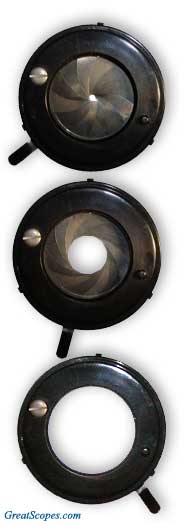 An iris diaphragm
is constructed of a number of interconnected "leaves" that, when adjusted
with a simple lever, open and close much like the pupil in your eye.
An iris diaphragm
is constructed of a number of interconnected "leaves" that, when adjusted
with a simple lever, open and close much like the pupil in your eye.
The beauty of such a device on a microscope is that it gives you almost an infinite number of settings. You are not limited to just six.
A good microscope is an investment in learning and adventure. An iris diaphragm can be an investment appreciated over and again. If a microscope you are looking at does not specify "iris" diaphragm, it likely has a disk type. The iris diaphragm is superior, and it will allow you to see things that simply cannot be seen with the disk diaphragm.
Using the iris in my EXM-150 I can easily see the internal organelles of the single-celled protozoa I find in a nearby lake.
GreatScopes offers student microscopes with both types of diaphragms, each is documented on its web-page.
Condenser
Just about every microscope also has something called a "condenser". This is the glass lens built into or under the stage. Its purpose is to gather and focus the light into an inverted cone (point up).
Since light travels in waves or particles, there are fewer of those waves/particles passing through your subject at high magnifications. A condenser focuses more of those particles on your subject, ensuring it is lit well enough to see.
A sub-stage, movable condenser comes into play in situations where high magnifications are used (1000x), where light is scarce.
You see, the location of the focal plane in relation to the light can vary, based on slide and/or subject thickness. Since the condenser is movable, it can be focused right on the specimen. The "Abbe" Condenser (pronounced just like the name "Abby") is the most common type.
At the risk of getting a little technical here, we need to talk a little bit about the "numerical aperture", or NA of the condenser. Your microscope manufacturer will take care of all the technical details of this for you, but if you are adding a lens (such as a 100x oil objective) to a microscope that you already own, the NA of the condenser must be greater than or equal to the NA of the lens that you are adding.
If you will be operating at 400x and below, you will do just fine with a fixed (not movable) condenser, most of which have a NA of .65. However, if you will be working at 1000x, a NA of 1.25 is common on such a lens, in which case a 1.25 NA movable/focusable condenser is required.
Again, when you buy a microscope, the manufacturer will take care of all this, but this will explain why some microscopes do not support 1000x magnification.
Filter Holder
A simple filter holder is built into with many microscopes. These can be useful in providing enhanced contrast and light color correction. In some cases, colored filters can be a simple substitute for staining, which would kill live specimens.
Mechanical stage
 Many of us are used to moving the slide around on the stage with our fingers.
In a lot of situations, that is just fine. However, there is a gadget that
is made for smooth, accurate movement of the slide. It is called a Mechanical
Stage.
Many of us are used to moving the slide around on the stage with our fingers.
In a lot of situations, that is just fine. However, there is a gadget that
is made for smooth, accurate movement of the slide. It is called a Mechanical
Stage.
A Mechanical Stage is a nice convenience, usually optional on student compound microscopes, and is standard equipment on medical and lab scopes.
A mechanical stage has two knobs. One moves the slide up and back, while the other moves the slide from left to right. These controls move the slide slowly and precisely, giving you exacting control of slide position.
If you are serious about looking at things under higher magnification, you will need a mechanical stage (as well as the fine focus discussed previously). A nudge of the slide while using 1000x magnification will take the subject completely out of view. Some wouldn't be without one at 400x - it just depends upon how nimble your fingers are!
Mechanical stages can be added to most student scopes by means of a thumbscrew, which holds it in place. Some scopes are not pre-drilled to accept a mechanical stage.
For general use, a mechanical stage is not a necessity, though it can be a nice option to have if it is in the budget. While the mounting holes are somewhat standard industry-wide, you are advised to obtain your mechanical stage from the same manufacturer as your microscope to guarantee proper fit.
Built-in mechanical stages are standard on our professional microscopes. On our student microscopes it is always an option, though have it as standard equipment.


Used Microscopes
From time to time, people ask us if they should buy a used microscope, or if we offer them for sale.
I imagine there are some decent used scope bargains out there. The problem is that most people are not qualified to properly determine a used scope's condition. Problems might lie in the optics and elsewhere, which might have undergone years jarring bumps and destructive impact in the hands of uncaring users. Such use can put a scope in pretty poor shape.
I once showed an inexpensive student microscope to the head of the Biology department at a large Southeastern university. After listening to his favorable comments, especially about the optics, he told me the optics were better than those on the $2000+ scopes at his school.
"How can that be?" I asked (remembering our $200 or so price tag).
"Because of the way that ours have been treated. Students don't handle our scopes the way they ought to. They're all out of whack."
That conversation taught me a few things.
First, that we have some nice scopes.
Second, not to buy a used microscope from an educational setting. You might get a great deal on a thousand-dollar scope, but the optics could be in shambles without your knowing it.
There is always a reason a microscope is being sold. Schools don't get tired of microscopes. They always will need microscopes. The students tear them up and wear them out! They are replaced when the majority are no longer fit for service. The fact is, without an expert evaluation, you have no idea whether you are getting a good one or one of the plenteous bad ones.
Unless you know how to evaluate and repair fine optical instruments, you'd be well advised to steer clear of used microscopes.
All equipment sold by GreatScopes is brand-new and factory fresh.

Conclusion
Congratulations! You made it!
Now you know more about microscopes than 99.9% of the general population, and more importantly you have what it takes to get the most microscope for your money, and the best one for your needs.
I hope you will consider GreatScopes for your upcoming purchase. We have selected the scopes that we carry because they meet a stringent set of criteria, and offer a lot of scope for the money. Won't you please visit www.GreatScopes.com and see what we have to offer?
If I can be of any further assistance in helping you select a microscope for your studies, research, or hobby, please contact me from our contact page.
If you would like to see a nice student microscope that meets all of the criteria mentioned, while still fitting most budgets, have a look at our EXM-150 Series. We have several others you'll see HERE.
If a professional level instrument is what you demand, have a look at our Revelation III or the EXC-120, a couple of reasonably priced professional instruments.
If we have been of assistance to you, we would love to have your business and look forward to meeting your microscope needs.
Best regards,
John Lind, Owner, GreatScopes